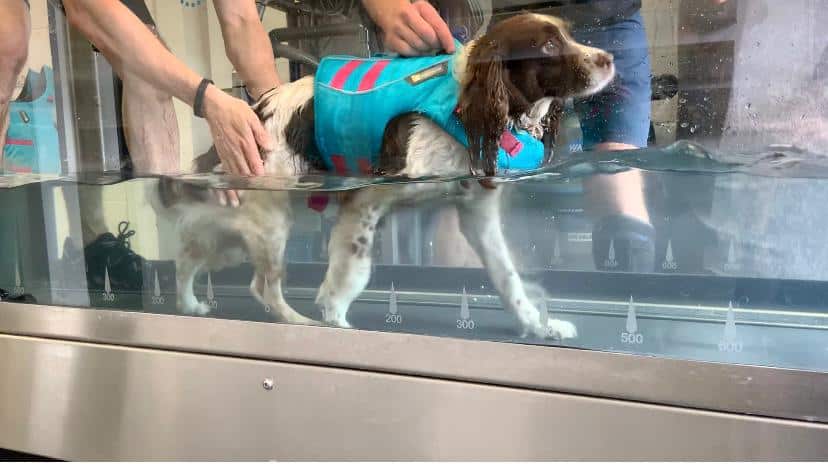
Level 4 Certificate in Canine Hydrotherapy (Bridging) Advanced Treadmill
Advance your Level 3 skills with focused theory and hands-on practice without committing to the full Level 4 Diploma. This IRVAP (ICH) and NARCH–approved bridging qualification strengthens safe, effective clinical work and meets evolving membership requirements.
You’ll cover:
Safety & welfare: Clinical Risk Assessment, health monitoring, and first aid.
Water operations: water management, biosecurity, and sustainable facility practice.
Clinical foundations: detailed canine functional anatomy and biomechanics for accurate assessment and planning.
Advanced methods: evidence-informed aquatic treadmill techniques.
Decision-making: structured clinical reasoning and assessment processes tailored to hydrotherapy.
Outcome: Confident, upskilled practitioners who can apply advanced, evidence-based hydrotherapy within an extended scope of practice
Build the core safety skills for water-based practice.
You’ll learn to:
Run Clinical Risk Assessments (CRA): hazard ID, risk rating, control measures, and hydrotherapy-specific ethics.
Screen effectively: thorough pre-session health checks; manage precautions vs contraindications.
Monitor in-session: continuous health and behaviour observation with clear criteria to progress, pause, or stop.
Meet your duties: legal and professional responsibilities when incidents occur.
Deliver first aid: practical CPR, bandaging, and safe emergency evacuation procedures.
Gain the clinical know-how and practical skills to run safe, compliant, and efficient hydrotherapy water systems.
You’ll cover:
Standards & duties: legal/professional responsibilities, record-keeping, and audit readiness.
Filtration & circulation: operating filters, scheduling backwash, and troubleshooting to maintain water quality.
Chemicals & testing: safe dosing and storage, routine test protocols, interpreting results, and corrective actions.
Biosecurity & hygiene: infection-control measures, cleaning workflows, and documented SOPs.
Plant operations: hands-on maintenance and daily/weekly hygiene tasks.
Sustainability: energy/water efficiency, eco-aware design, and smart equipment choices.
Outcome: Confident management of water quality and biosecurity, with sustainable practices embedded across the facility.
Build the anatomical insight and hands-on skills needed for accurate assessment and effective hydrotherapy.
You’ll cover:
Nervous system & proprioception: roles of major peripheral nerves and how proprioceptive input drives posture, balance and gait.
Muscle biomechanics: prime movers vs stabilisers, key muscles for locomotion, and the influence of postural tone.
Fascia & lymphatics: tissue continuity, fluid movement and implications for swelling, pain and recovery.
Cardio-respiratory systems: structure, function and adaptation to aquatic exercise.
Therapeutic palpation: locating and differentiating major muscles, bony landmarks and joint lines to identify movement dysfunctions.
Outcome: Confidently link structure to function and use skilled palpation to inform precise, evidence-based hydrotherapy plans.
Develop a structured, evidence-informed approach to assessing dogs and planning safe, effective hydrotherapy.
You’ll cover:
-
Assessment components: thorough subjective history and objective exam (observation, palpation, ROM, gait, pain/behaviour cues).
-
Goal setting: create SMART goals aligned to functional outcomes and owner priorities.
-
Clinical reasoning: choose appropriate techniques, manage precautions vs contraindications, and adapt sessions in real time.
-
Re-assessment & outcomes: use valid, reliable measures; establish baselines; track progress; know when to escalate, refer, or discharge.
-
Communication & MDT working: clear explanations, informed consent, concise notes/reports, and effective collaboration with owners and the multidisciplinary team—including strategies for difficult conversations.
Outcome: Confident, systematic assessment that justifies treatment choices and supports measurable, safe patient progress.
Build the skills to plan and deliver safe, effective treadmill sessions tailored to each dog.
You’ll learn to
-
Choose the right approach: use assessment, behaviour, anatomy, breed traits and pathology to select treadmill techniques.
-
Run safe sessions: therapeutic prep, equipment checks, controlled entry/exit, and continuous health monitoring.
-
Apply techniques:
-
Proprioception: stride placement, cadence changes, perturbations, dual-tasking.
-
Movement shaping: targeting/luring, stance and step-width adjustments.
-
Therapeutic exercise: dosing speed, water depth, incline and intervals; integrate manual therapy where appropriate.
-
-
Review & adapt: evaluate effectiveness, provide aftercare and home exercise, and adjust plans based on real-time canine response.
Outcome
Confident delivery of evidence-informed treadmill programmes that improve mobility, strength and function, with clear safety and clinical rationale.
Practical Training & Assessment 3 Days, Poole (Student Guide)
Put your theory into practice with expert support at our Poole centre.
What to expect
Expert-led learning: live demos, guided practice and personalised feedback from highly qualified hydrotherapists.
Real cases: assess, treat and build tailored plans for dogs with varied ortho/neuro needs.
Core skills refined: aquatic treadmill techniques, appropriate manual therapies, and robust health monitoring throughout each session.
Clinical confidence: practise decision-making in real time—when to progress, pause or refer—so your treatments are safe and effective.
Outcome: You’ll leave competent in technique and confident in clinical reasoning, ready to deliver high-quality hydrotherapy in practice.
Canine Hydrotherapy Overview (Level 4 Certificate, Bridging)
Canine hydrotherapy uses controlled, water-based exercise to aid rehabilitation, improve mobility and support overall wellbeing especially for dogs with musculoskeletal or neurological needs. By combining functional anatomy, biomechanics and pathology with practical techniques, hydrotherapy improves strength, flexibility and joint function while keeping impact low. Safe practice depends on sound clinical risk assessment, ongoing health monitoring and competent first aid all taught in this programme.
What this course covers (Aquatic Treadmill focus)
Clinical reasoning: assess each dog’s history, anatomy, behaviour and health status to select suitable treadmill interventions.
Techniques in practice: therapeutic exercise, movement shaping and appropriate use of manual therapy to improve muscle function and joint mobility.
Safety & standards: CRA, contraindications/precautions, welfare-first handling, outcome tracking, and when to progress, pause or refer.
Operations & responsibility: sustainable water management, biosecurity, and legal/professional duties.
Outcome
Graduate able to design and deliver evidence-informed, individualised aquatic treadmill programmes, monitor progress and adjust dosing and technique providing high-quality hydrotherapy that supports long-term mobility and health.